Bank of England Poised to Raise Interest Rates to 4% in First Hike Since 2023
The Bank of England is widely expected to raise interest rates on Thursday, in what would be its first increase in more than three years, as mounting inflation pressures linked to the US-Iran war force policymakers to change course.
Economists polled by Reuters expect the Bank’s Monetary Policy Committee (MPC) to vote 7-2 to lift Bank Rate to 4% from 3.75%. If that happens, it will be the first rise since August 2023, when inflation was running above 6%, and the first change in rates of any kind since a cut last December.
Financial markets are even more convinced. Derivatives market data implies a 96.7% chance of an increase at Thursday’s meeting, according to analysis published this week, while investors had already priced in a near-100% probability of a November move by late October.
The decision, due on Thursday 5 November, comes a day after Chancellor John Healey’s first Autumn Budget, which included a one-off £100 payment towards energy bills for 20 million households.
Why the Bank is expected to act
The case for a rise rests above all on inflation. Annual consumer price inflation reached 3.5% in September, higher than economists had expected, well above the Bank’s 2% target, and above the 3% it had predicted in late July in its last full set of forecasts. That reading was an 11-month high.
The main driver is energy. The US-Iran war has pushed fuel prices sharply higher, and the Bank’s September minutes recorded the scale of the shock: between the period before its July forecast and the close of business on 14 September, spot Brent crude rose 36% to $106 a barrel, while UK wholesale gas climbed 78% to 207 pence per therm. Using energy prices at that date, the Bank projected inflation of around 3.75% in the final quarter of 2026 and slightly above 4% in the first quarter of 2027.
That pressure is set to intensify for households. The energy regulator Ofgem’s price cap for a typical household increased 3.6% on 1 October, with a further rise of around 22% forecast for January, and analysts at ING say a rise of circa 25% in the regulated cap in January is all but baked in. ING expects headline inflation to peak a touch above 4% early next year.
At its last meeting in September, the MPC voted 6-3 to keep rates on hold. Three members — Megan Greene, Catherine L Mann and Huw Pill — already favoured raising rates immediately by a quarter of a percentage point to 4%, according to the Bank’s minutes. Since then, the inflation data has moved further in their direction, and the Reuters poll suggests the majority is now expected to join them.
What it means for households and borrowers
A rise to 4% would be a quarter-point move, but its effects would be felt unevenly. Borrowers on tracker mortgages, whose rates move in line with Bank Rate, would typically see their monthly payments rise fairly quickly, while savers could see slightly better returns on variable-rate accounts, though banks do not always pass on the full increase.
For households already facing higher energy bills, the timing is awkward. The Budget’s £100 energy payment is a one-off measure, whereas higher borrowing costs would feed through to mortgages, loans and credit cards over time. The Office for Budget Responsibility, in its post-Budget analysis, revised its inflation expectations for 2027 upward to 3.5%, from the 2.1% it had expected back in March.
A divided committee — and more rises ahead?
Even if Thursday brings a rise, the debate inside the Bank is far from settled. Some policymakers worry that raising rates too aggressively could choke off growth, while others argue that failing to act risks letting higher energy prices feed into wages and prices more broadly. That split was visible in September’s 6-3 vote, and Thursday’s expected 7-2 result would still leave two members unconvinced.
Markets already price in at least three further quarter-point rises next year, on top of one this month, and ING thinks a follow-up move in February is more likely than not, barring a collapse in energy prices. As Suren Thiru, chief economist at the Institute of Chartered Accountants in England and Wales, put it, an “interest rate rise to 4% looks all but certain”.
More from The Digi News
- Healey to Unveil Cautious First Budget as Borrowing Costs Climb
- UK Shop Prices Rise at Fastest Pace in Two-and-a-Half Years as Retailers Warn ‘Dam Is Starting to Break’
- Browse more Business
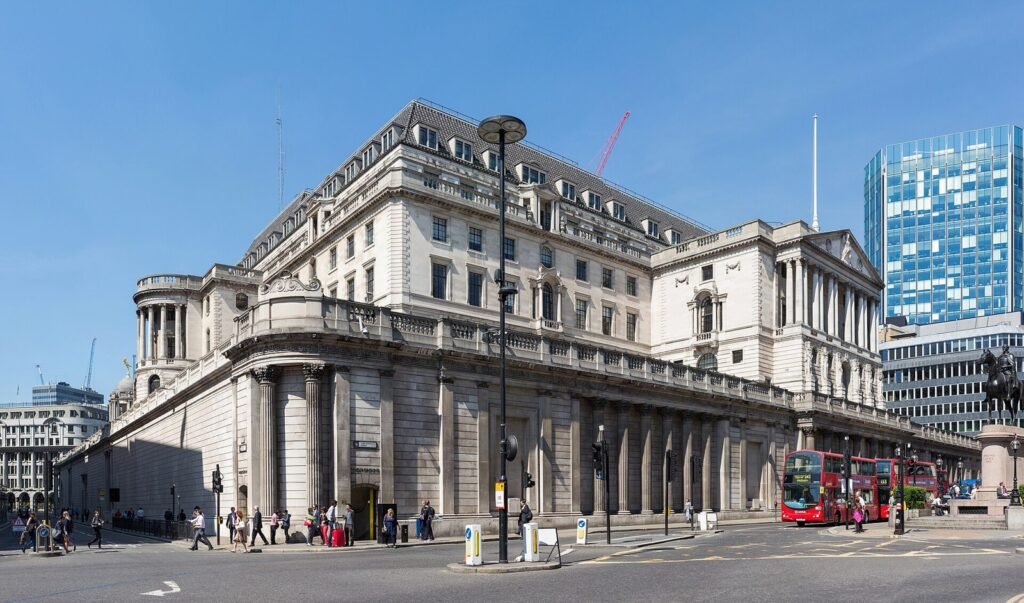
Featured image: The Bank of England building, London. Photo by Diliff via Wikimedia Commons (CC BY-SA 3.0).