Hoax Bomb Threats Disrupt Dozens of European Flights as Hybrid Attack Fears Grow
A wave of hoax bomb threats against passenger flights has disrupted air travel across Europe for most of the past week, forcing emergency landings, diversions and fighter-jet escorts at airports in more than a dozen countries. No explosives have been found on any aircraft, and no one has been hurt, but the scale and speed of the threats have alarmed governments already on alert for what they describe as hybrid attacks.
The disruption began on Monday 2 November, when a Wizz Air flight from London Luton to Sofia was diverted to Budapest and escorted by a Hungarian fighter jet after a bomb threat. The following day, at least seven flights and an Israel-bound cruise ship were targeted. A LOT Polish Airlines flight from London Heathrow to Warsaw was diverted to the Polish capital’s other airport, Warsaw-Modlin, which was briefly closed while the aircraft was searched. A Scandinavian Airlines flight from Copenhagen landed at Warsaw Chopin Airport as scheduled, where a runway was closed while the plane was inspected. In Italy, two Eurofighter jets escorted a Ryanair flight from Dublin into Rome’s Fiumicino Airport, where it landed safely. A Ryanair flight from Manchester to Murcia in Spain prompted parts of the airport to be cordoned off, and two flights bound for Sofia were inspected after landing. Every search came back clear.
On Thursday 5 November, a second and larger wave hit. At least 25 flights across 16 countries were disrupted, operated by at least ten carriers including Ryanair, Aer Lingus, Wizz Air, Finnair, easyJet, Aegean Airlines, Iberia, Air Serbia and LOT Polish Airlines. An Aer Lingus flight from Dublin to Rome was diverted to the Evreux military air base in France, where all 151 passengers and six crew were taken to safety while a bomb squad checked the aircraft. A Finnair flight from Helsinki to Rome was intercepted in Croatian airspace by a Croatian fighter jet and handed over to Italian air force jets. Three Ryanair flights bound for Sofia made emergency landings, two in the Bulgarian capital and one in Plovdiv, after the threats were found to be baseless.
Threats reach Britain and spread to newsrooms
Britain was caught up in the disruption too. The Metropolitan Police aviation command assessed overnight threats against four aircraft at Heathrow and Birmingham airports as hoaxes and reported no security issues. The disrupted flights were a small share of the 27,400 flights that Eurocontrol, the body that coordinates European air traffic, had scheduled for Thursday.
The threats continued on Friday 6 November, with at least 17 flights disrupted by midday, and the campaign spread beyond aviation to newsrooms in Ireland, Bulgaria and Britain. Police in Copenhagen said security checks at the city’s airport had found “no danger to passengers”. By the end of the week, at least 33 flights had been disrupted in total.
Who is behind the threats?
No one has claimed responsibility, and no government has named a suspect. Investigators said on Thursday they had found no evidence of a hostile state or terror group, and the European Union’s transport commissioner, Apostolos Tzitzikostas, said it was too early to say whether the incidents were connected. Some emails threatening Rome- and Sofia-bound planes were signed by fighters of a Russian far-right misogynist movement, according to reports, but officials have not attributed the wider campaign to any group.
The pattern has nevertheless raised fears of hybrid warfare, the term governments use for pressure kept below the threshold of open conflict. Poland has introduced extraordinary measures against hybrid threats, and European officials have warned that Russia may be stepping up such operations, although no evidence has been presented linking Moscow to the bomb threats. Aviation risk analysts have noted that the threats, even when false, are cheap to make and expensive to answer, because every warning must be treated as real until a search proves otherwise.
For passengers, the week has been a reminder of how quickly a handful of messages can ground an industry. Flights were delayed, diverted and searched, airports closed runways and terminals, and military jets were scrambled across the continent, all for threats that turned out to be empty. The cost has been measured in disruption rather than casualties, but with investigations still under way and no one yet identified as responsible, European aviation authorities are braced for more.
More from The Digi News
- Trump Approves $2.1bn Sale of 500 Patriot Missiles to Ukraine — But Kyiv Warns Delivery Could Take Years
- Lula Wins Fourth Term in Brazil as Bolsonaro Contests Runoff Result
- More World News from The Digi News
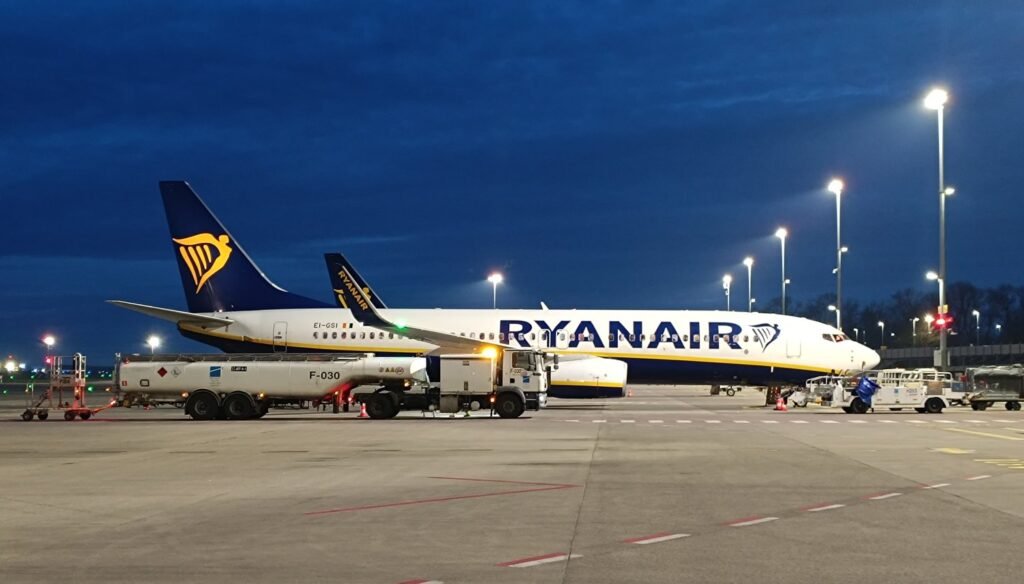
Featured image: A Ryanair Boeing 737 at Charleroi-Brussels South Airport. Photo: Hotolmo22, via Wikimedia Commons (CC0).